Can AI Learn the 'Feel' of a Veteran Technician? EES-APC Turns Process Tuning into a Computable Capability
Manufacturing has a very real problem: the most valuable process experience in a factory is mostly held by a few veteran employees on the shop floor, and it depends entirely on their hands-on feel.
Process engineers on coating lines frequently watch grammage curves, and their biggest fear is waiting until the web is taken down and weighed before discovering that thickness has already drifted;
Pump room technicians have to run to the site every two hours, afraid that cooling water temperature drift will affect the entire production line;
Wire-slicing shift leaders constantly patrol the site. Once a wire break is found, a whole bar and a whole roll of diamond wire are scrapped immediately.
These tasks all rely on a feel honed over years on site. But feel has a fatal problem: it is very hard to hand over and pass on. When shifts change, the people tuning parameters change, and the tuning logic is all in their heads. When a real problem occurs, no one can clearly say who changed which parameters. Alarm information, equipment history, and process records are scattered across different systems. Old experience cannot be copied or reused, and when a problem occurs, there is no way to trace the process back.
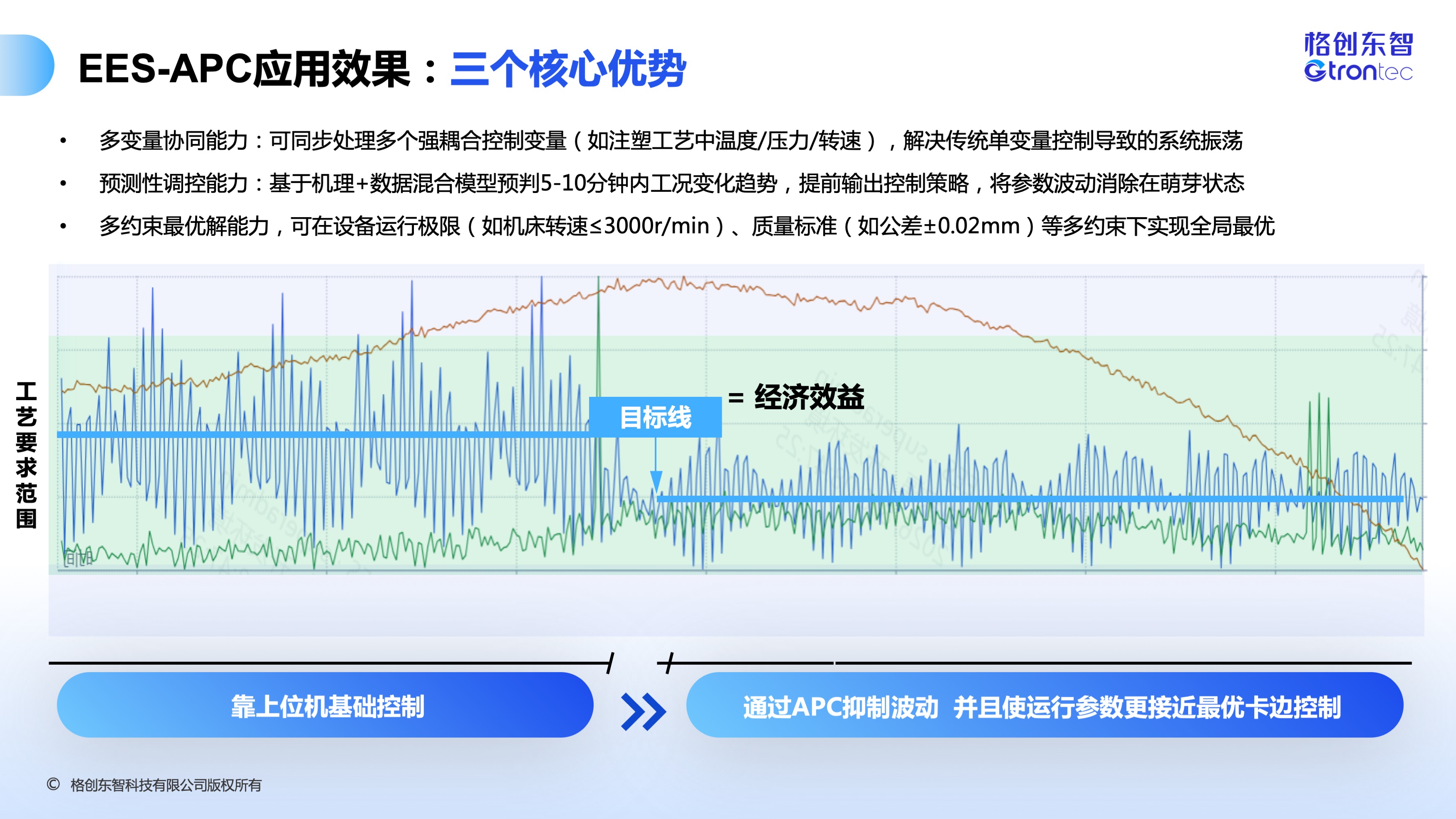
Getrontec EES-APC (Advanced Process Control) addresses exactly this pain point. It does not replace PLC or DCS, never touches safety interlocks, and will not bypass engineers to take over machines directly. What it does is turn the master technicians' tacit hands-on experience into rules that the system can execute.
EES-APC connects equipment operating status, on-site process conditions, and engineers' accumulated engineering experience. Within the original control system and safety boundaries, it provides process engineers with data-backed analysis suggestions and supports automatic parameter tuning and execution within controllable limits.
Equipment running normally depends on EES-PHM's condition monitoring and prediction. But whether the process is always in the optimal state while the equipment runs normally depends on EES-APC's process consistency monitoring and tuning.
The control system supplied with the production line is good at strictly holding given setpoints and ensuring stable equipment operation; this is the foundation of production. But equipment wears and ages, sensor errors increase, the workshop environment fluctuates, and loads and process models keep changing, so process conditions will slowly deviate from the optimal range. The same set of parameters does not deliver optimal results when switched to different recipes or production batches.
What really troubles engineers is not only whether to adjust parameters, but also which indicator to adjust, by how much, and when it is most appropriate to act.
Take cooling water temperature. When the temperature is high, it is not simply a matter of raising pump speed. Current, vibration, equipment load, and downstream process requirements all need to be considered. Quality fluctuations in coating, etching, and slicing cannot simply be blamed on one single parameter.
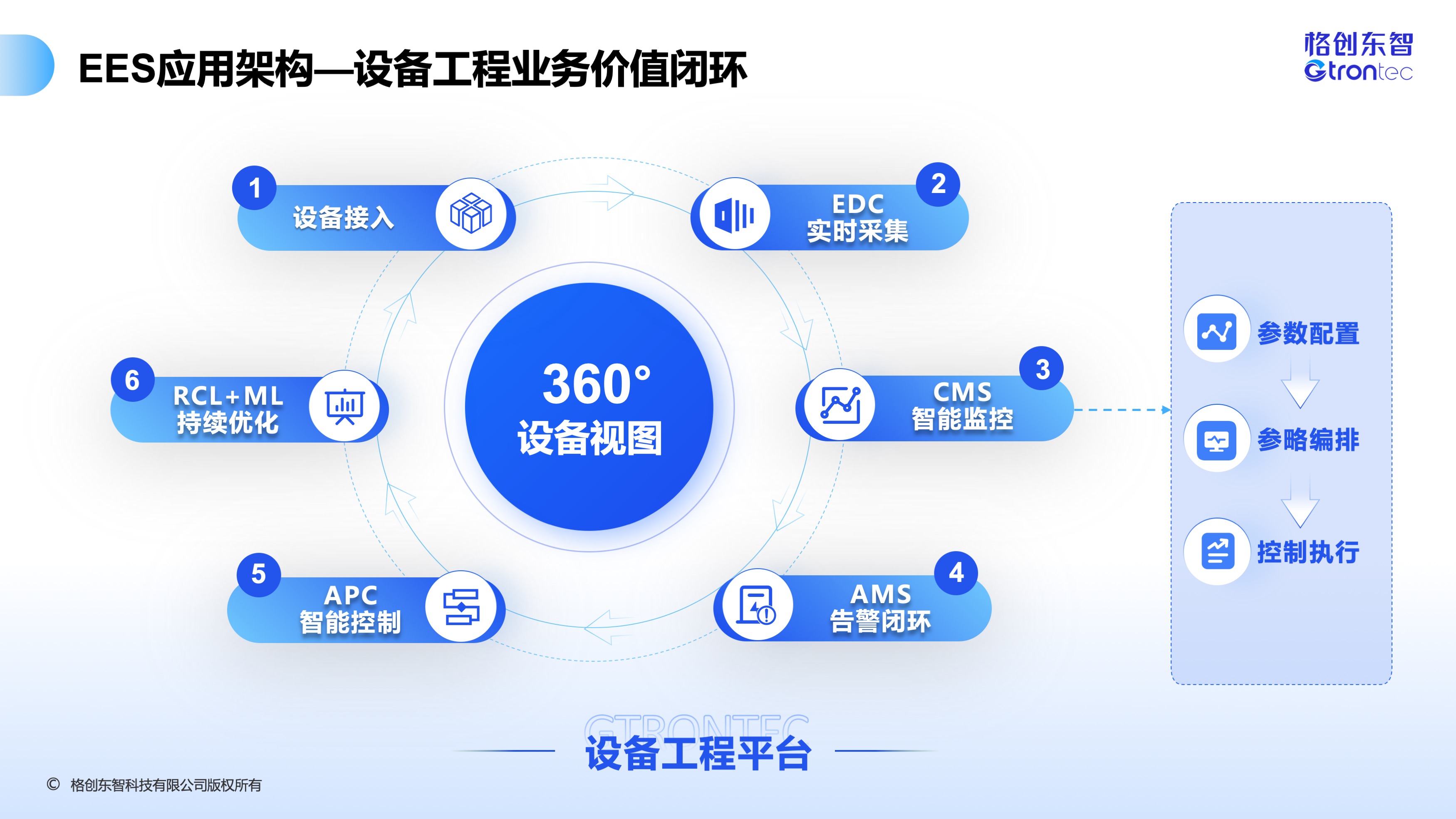
Getrontec EES links equipment, components, measurement point data, alarms, conditions, production recipes, batch information, and failure modes together. Engineers can first clarify the conditions under which the problem occurs and the various influencing factors, refer to similar cases from history, and then decide whether to output only suggestions, require manual approval, or execute directly under control. For every step, the corresponding data source, rule version, and execution result can all be traced and reviewed.
Pump group water temperature: holding the critical 1℃ fluctuation
Utilities engineers know very well that if cooling water temperature drifts by just 1-2℃, the temperature stability of downstream processes such as coating ovens, wire-slicing cooling, and developing/etching will all be thrown off.
What the site used to do: if water temperature was high, raise the pump frequency; if current hit the upper limit, it could only be lowered again; if vibration increased, no one dared to keep raising it. With insufficient staffing on night shifts, setpoints were simply set very conservatively. In the end, electricity costs did not go down, but capacity could not increase.
After connecting to EES:
When water temperature deviates from the target value, the system adjusts the inverter according to the deviation size and duration, but the single adjustment amplitude and per-second rate of change are limited. There will be no aggressive action such as jumping frequency directly from 30Hz to 48Hz. It also considers current and vibration. Within the constraints of meeting water temperature targets, not overloading current, and not exceeding vibration limits, it finds a suitable operating frequency rather than focusing only on a single alarm threshold. At the end of a shift, if the average water temperature is overall high, the next shift slightly adjusts the target temperature by 0.5-1℃.After the upgrade, nighttime water temperature drift was compressed from more than ±1.5℃ to within ±0.5℃. On-site duty also changed: there is no need to inspect the pump room every two hours, and on-site handling is required only when an abnormality occurs. No one needs to be assigned specifically to watch water temperature.
Lithium battery coating: don't wait until the whole roll is measured to find out parameters were not tuned well
On lithium battery electrode production lines, slurry, slot die, web speed, oven, and calendering are all interconnected and affect one another.
What the site used to do: many production lines still used fixed-recipe open-loop production. Grammage and thickness were only known after the whole roll was completed and tested offline. Foil moves one meter per second; by the time an out-of-tolerance condition is found, tens of meters of waste foil have already been produced.
To reduce defects, line speed was often deliberately given a large margin, and oven temperature was set high. Capacity could not increase, and electricity was wasted. Thickness was uneven across the coating width, and at the calendering stage, the roll gap would further amplify this deviation.
After connecting to EES:
Grammage is monitored in real time at multiple points across the width, and the slot die or zone actuators are dynamically adjusted. Along the web length direction, if the previous section is too thick, web speed is adjusted in time without waiting until the whole roll is finished for remediation. When measured data cannot keep up, soft sensing is enabled as an auxiliary, estimating real-time grammage based on line speed, slot opening, slurry state, and oven temperature. Only when the estimate confidence is high enough does it participate in closed-loop regulation. If the estimate is inaccurate, the closed loop is automatically released, and unreliable data is never used to change the machine. If this section of foil is too thick, a signal is sent ahead to the calendering process to compensate calendering pressure, so density abnormalities are not discovered only after calendering is complete. At the end of a roll, if average grammage is overall high, the next roll is automatically slightly corrected. Abnormal rolls such as those from web breaks or shutdowns are not used as tuning baselines.Wire slicing machine: a wire break costs an entire silicon rod
In multi-wire slicing, diamond wire tension, feed speed, cooling, wire travel speed, and wire wear constrain one another and directly determine TTV, warpage, and whether wire breakage occurs. As wire gets older, tension and feed must be changed accordingly. In the past, this relied entirely on shift leaders' experience. Once a wire breaks, the silicon rod, coolant, and labor hours are all wasted.
EES uses a layered control approach. During normal cutting, tension and feed follow established setpoints; once a wire-break interlock is triggered, feed stops immediately, and tension is not forcibly increased to keep cutting. As diamond wire continues to wear, the tension parameter table is updated in segments according to cumulative cutting length, and wire from different suppliers is configured with its own set of parameters. After one rod is cut, if TTV or wire-break count exceeds limits, parameters are fine-tuned for the next rod.
The difficulty in this scenario is trading off multiple conditions: TTV and warpage must meet standards, while wire-break probability and diamond wire wear must be reduced. The system finds a balance point within upper and lower constraints and will not break the diamond wire just to pursue uniformity one-sidedly. The premise of AI automatic optimization is clear objectives, explicit constraints, and controllable execution boundaries.
The three real scenarios above are typical cases of transferring experience that was originally highly dependent on people to the system.
Special note
For advanced automatic control of equipment processes to truly land on the production line, the following must first be clarified: Which situations absolutely must not be left to automatic handling? Safety interlocks and emergency stops must have the highest priority. Where are the boundaries for parameter adjustment? Upper and lower limits, rates of change, applicable conditions, and failure fallback conditions must all be sorted out in advance. Who has the authority to confirm execution? High-risk scenarios and newly launched trial runs require retained manual oversight. How are exceptions handled? Automatic functions can be turned off at any time and switched back to manual mode, with complete traces of all operations.In actual projects, a more pragmatic approach is to select a real scenario with clear boundaries and strong verifiability for a pilot first. For example, condition stability of a single key piece of equipment, recurring parameter drift, or a process that requires repeated parameter tuning based on batch results. First clarify the data, variables, constraints, and responsible persons, use historical data combined with on-site experience to validate the strategy, and prioritize analysis and suggestion modes. After operating results and boundary conditions are stable, gradually expand the scope of controlled automatic execution.

The first-phase 'AI EES 100 free licenses open' campaign is still recruiting. We are opening co-creation of real APC advanced process control loops to existing customers. Fill out the questionnaire to sign up. We complete screening within 48 hours, and a specialist will follow up. We hope manufacturing plants, in equipment engineering construction, can not only see data and find records, but also truly stabilize processes and achieve global optimization.